
Are Trade Jobs Safe From AI?

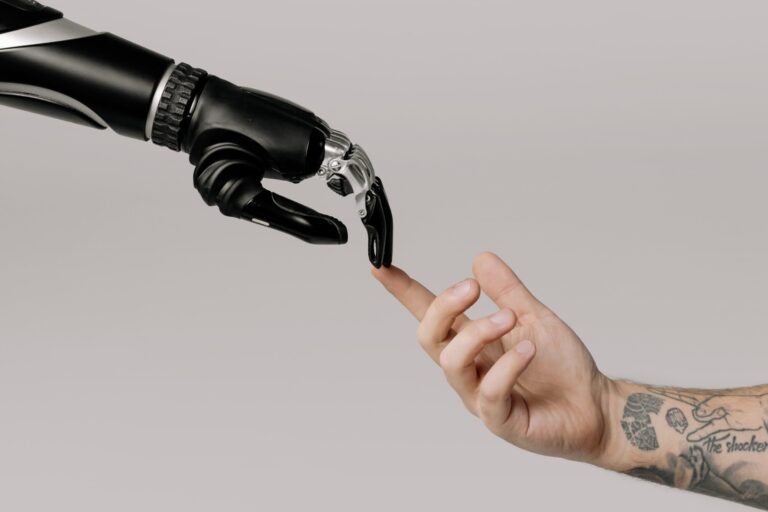
Human hand touching a robotic hand.

Today’s culture is filled with stories about the wondrous achievements of Artificial Intelligence, usually shortened to “AI.” What once was the stuff of science fiction movies has now become a reality, with some experts regarding it as the initial step for computers to become smarter than their human programmers. Of more immediate concern to many people, though, is the impact on our economy and in the workforce. AI is the most powerful form of automation the world has ever seen, and many people are fearful that it will eliminate many jobs.

Can trade workers be replaced by machines? That would seem to be the implication of predictions like the one made by a computer scientist at Rice University, who forecast that by 2045, machines will be capable of doing almost any job a human can. Many white-collar professionals once thought to be immune to automation, like lawyers and writers, now seem threatened by that reckoning. Maybe so, but the picture looks very different for trade workers.

Have Tech Predictions Ever Been Right?

The far-off world of tomorrow has always been filled with wonders to come. People would get around in flying cars. Robots would do away with household drudgery.

It’s worth remembering how few of those predictions panned out. In 1955, around the same time commercial nuclear reactors were being built helter-skelter, trade publications were discussing the coming era of nuclear-powered residential boilers. People genuinely believed electricity would become too cheap to meter.
Robots work in a warehouse.Automation has taken over quite a few chores in the past several decades. Of course, many jobs in manufacturing and warehouse work have been taken over by robots and automated processes. Now that computers are a fixture at every white-collar desk, there is no need for businesses to employ a small army of clerk-typists, nor do phone companies require switchboard operators to connect calls.

Although some may lament the loss of those jobs, new jobs have arisen that are even better. Do not be afraid of progress. The future no doubt will be filled with wondrous things we can scarcely imagine right now. After all, nobody envisioned the internet a half-century ago.
Why Are Trade Jobs Safe From AI?

Trade workers, especially, have no reason to be afraid. Although some robotic systems have made inroads into construction projects, highly skilled work remains almost exclusively in human hands. Most trade work is not of an assembly-line variety. Some construction assemblies are fabricated in workshops, but trade workers are still involved because the volume of assemblies is seldom sufficient to justify investing in robots to do the work.

In the service sector, automation is even less of a factor. Even if a machine could be exquisitely programmed to perform repair and maintenance tasks, there is real doubt that many homeowners would feel comfortable watching a metal contraption fiddle with their plumbing, HVAC, or electrical systems.

It’s not too far-fetched to believe that machines may someday learn to prefabricate many of the plumbing, piping, and electrical systems in new construction, much like what happens on a factory assembly line. Yet it will be much harder to program a device to duplicate all the complex diagnostics and wrench-turning that takes place in service calls.

Martin Ford, the author of The Rise of the Robots, put it plainly in an interview on the Futures podcast: “Things like electricians and plumbers, where you’re really problem-solving in unpredictable environments; areas that require a lot of mobility and dexterity. If you want to build a robot that can do what an electrician does, that really requires science-fiction technology. It’s going to be a long time before we can do that. These are the kinds of areas where the jobs that are being done by people are going to be safer.”

Research backs this up:


These aren’t jobs that are “surviving” AI disruption — they’re growing because of the physical, unpredictable nature of the work.

What Happens When Robots Replace Workers?

Consider what happened when Walmart experimented with using roving robots in store aisles to track inventory. The retail giant contracted with a robotics company, thinking it would help reduce costs, and deployed robots in around 500 of its 4,700 U.S. stores. It found that human workers were even more productive, helpful, and even increased sales. A significant number of shoppers were also simply creeped out seeing the robots in action. The experiment was scrapped.

Automation Changes Trade Work, It Doesn’t Replace It

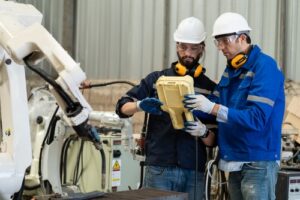
Two workers program a robot armTwo points are worth making here. First, automation does eliminate certain jobs, but it frees people to create many others. Blacksmiths gave way to auto mechanics. Telephone and elevator operators are largely gone, but many new kinds of jobs have arisen since their heyday. One study by an economics professor at MIT estimated that 60% of today’s jobs did not exist in 1940.

Second, skilled trade jobs are more immune to advances in technology than most. Automation has already drastically changed trade work. Back in the late 1800s, plumbers had to fabricate their own pipe. That labor-intensive task is long gone, but plumbers are needed more than ever. Many labor-saving devices have also affected the HVAC and electrical trades, yet employers still face severe shortages of those workers.

That shortage is getting worse, not better. The Infrastructure Investment and Jobs Act allocated more than $50 billion for water infrastructure, all of which will require plumbers. The AI buildout is making electricians harder to find than ever: the Center for Strategic and International Studies notes that each megawatt of AI data center capacity requires roughly 1,800 electrician-hours, and Google announced a $10 million grant in 2025 specifically to train more electricians for AI-driven construction. AI is creating demand for trade workers, not replacing them.

Where AI Fits In

AI could prove immensely valuable to skilled trade workers in diagnosing problems and advising on fixes. But someone will still have to turn the screwdrivers and wrenches to make things work. It’s possible to envision machines that perform such tasks, but humans will still be needed to direct those machines to turn screwdrivers and wrenches in the right places.

Technological advances through the ages have made trade work less physically demanding yet more productive. Still, the jobs remain in high demand, and likely will throughout our lifetimes.

Skilled trade workers will continue to be in high demand for many, many years and decades from now. For students exploring their options, trade careers in plumbing, HVAC, and electrical offer something increasingly rare in today’s economy: AI-proof jobs with strong wages, real-world skills, and a clear path forward.

Not sure which trade is right for you? Take our career quiz or find apprenticeship opportunities near you with our Apprenticeship Map.